
Circle Contracting / How we tile
How we tile: the parts you don't see
Most tiling problems start underneath the tile. A floor that holds water, a shower that leaks into the next room, a tile that sounds hollow a year later. All of it goes back to prep, waterproofing and adhesive. This page is how we do those parts, so you know what you're paying for.
Wet areas and dry areas
A wet area is any room where water is used and ends up on the floor or walls: bathrooms, ensuites, showers, laundries and toilets. A dry area is everywhere else: living rooms, hallways, bedrooms, and kitchens outside the splashback.
The difference matters because the rules are different. In a wet area, the National Construction Code (NCC 2022, Part 10.2) and the waterproofing standard AS 3740-2021 set out what has to be waterproof, what has to be water resistant, and how far the floor has to fall to the waste. For example:
- The whole shower floor, and the shower walls to at least 1800 mm above the floor, must be waterproof.
- Every wall-to-floor junction in the bathroom must be waterproof, including outside the shower.
- Laundry and toilet floors must be at least water resistant, with the wall-to-floor junctions sealed.
In a dry area the priorities are flatness, adhesive coverage and movement joints. A living-room floor doesn't need a membrane, but it does need a flat base, or large tiles will rock and lip.
Screeds and falls
A screed is a layer of sand and cement (or an engineered screed mix) laid over the slab to create the shape the tiles need. In a shower, that shape is a fall: the floor slopes to the waste so water drains away instead of sitting in the corners.
Screeding to falls is where a lot of showers go wrong. NCC 2022 requires a shower floor to fall to the waste at no flatter than 1:80 and no steeper than 1:50. Across a 900 mm shower that's at least 11 mm of drop. Too flat and water ponds. Too steep and the floor feels wrong underfoot and tiles won't sit properly. We set falls with a level and check them before any membrane goes on.
For showers and floors where time matters, we use a rapid-set screed such as ARDEX A 38, which can take floor coverings the same day. For dry floors that are out of level, a self-levelling compound such as ARDEX K 15 gives large tiles the flat base they need.
Where the shower has no hob, the shower floor is stepped down or finished with a level threshold and a waterstop, so water stays in the shower. If there's a step-down, NCC 2022 sets it at a minimum of 25 mm.
Waterproofing
The aim of a wet area is simple: no leaks, into the next room, the slab or the wall cavity. Tiles and grout are not waterproof on their own. The membrane underneath is what keeps the water in, and the only time to do it properly is before the tiles go down.
We waterproof to AS 3740-2021. On a typical bathroom that means:
- Prime the substrate so the membrane bonds, for example with ARDEX WPM 265.
- Bond breakers at every wall-to-wall and wall-to-floor junction, so the membrane can stretch when the house moves instead of tearing.
- Puddle flanges at the floor wastes and sealed penetrations at taps and pipes, where most leaks start.
- A waterstop at the edge of the shower and across the doorway, so water can't track under the tiles into the next room.
- The membrane itself: two coats of a Class III membrane (the highest-extensibility class under AS 4858), to the thickness the manufacturer specifies. ARDEX WPM 002 is a two-part, fibre-reinforced undertile membrane; ARDEX WPM 155 Rapid Plus is an engineered membrane with a faster drying time.
- Full cure before tiling. The drying time on the product is a minimum, not a suggestion. We don't tile over wet membrane to catch up on a schedule.
Waterproofing is the one part of a bathroom you can't inspect once it's finished, and the most expensive to fix. It's the part we never rush.
Tile adhesives
The adhesive has two jobs: hold the tile, and fill the space under it so there are no hollow spots. Hollow spots crack under load and let water sit under wet-area tiles. AS 3958.1 asks for at least 90% adhesive coverage in wet areas and outdoors. For large tiles we back-butter, spreading a thin coat on the back of the tile as well as the floor, and lift a tile now and then to check the coverage.
Which adhesive depends on the tile and what it's going onto:
- ARDEX X 77: a premium, flexible, fibre-reinforced adhesive for walls and floors. Our everyday choice.
- ARDEX X 17: flexible and non-slump, made for large-format and heavy tiles, especially on walls.
- ARDEX X 56: fast setting and highly flexible, for timber floors, heated slabs, and jobs that need to be walked on sooner.
- ARDEX Optima: a two-part adhesive for difficult surfaces, including tiling over existing tiles without grinding off the glaze.
Tile sizes and formats
Tile size changes how a job has to be done, not just how it looks.
Mosaics and small tiles
Mosaic sheets and small tiles bend easily around falls, which makes them a good fit for shower floors and curved surfaces. They have more grout joints, so grout choice and colour matter more.
Standard formats: 300 × 300, 300 × 600
Forgiving and versatile. Still set out to a plan, so cuts land in the right places.
Large format: 600 × 600, 600 × 1200, 1200 × 1200 and up
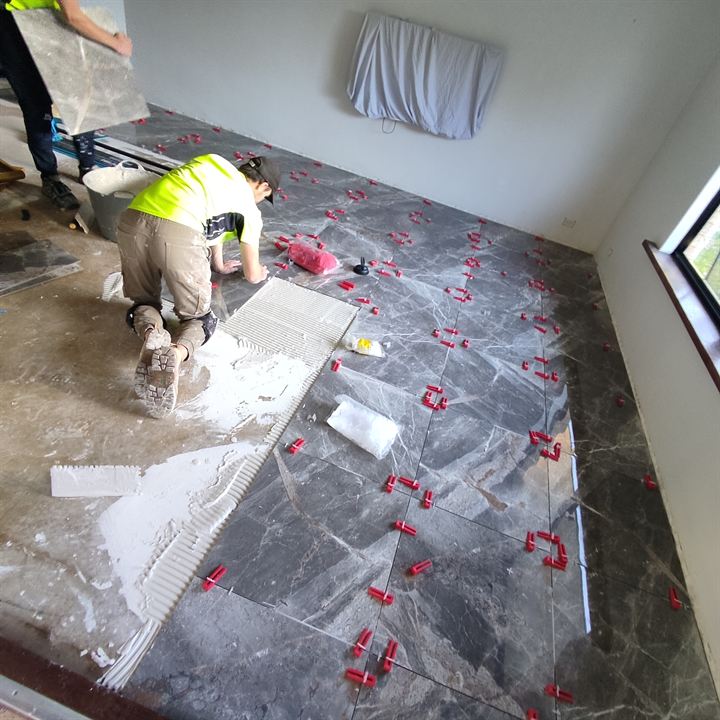
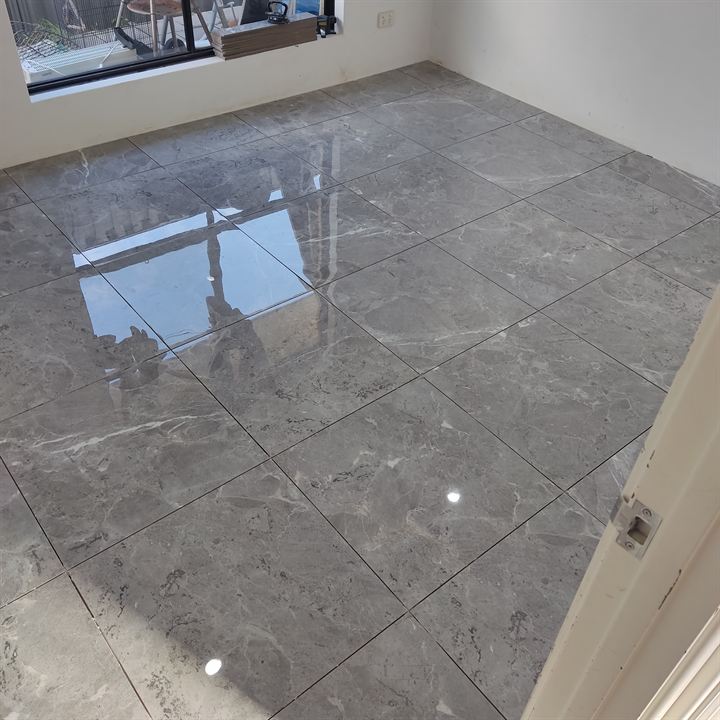
Large tiles give a clean, modern look with fewer joints, but they show every flaw in the floor underneath. What we do differently:
- Check flatness first with a long straightedge, and level the floor with a screed or self-leveller if it's out.
- Back-butter every tile for full coverage.
- Use a levelling clip system, so neighbouring edges sit flush and there's no lippage (one tile edge higher than the next).
- Keep brick-bond offsets to about a third on long rectangular tiles. Manufacturers generally recommend this, because every tile has a slight bow from the kiln. A half offset lines up the high middle of one tile with the low end of the next.
- Plan the shower floor. A large tile is flat and a shower floor falls in more than one direction, so it needs either envelope cuts that follow the falls or a strip drain along one edge.
- Two people to handle the biggest tiles, so they don't crack before they're laid.
Layout and set-out
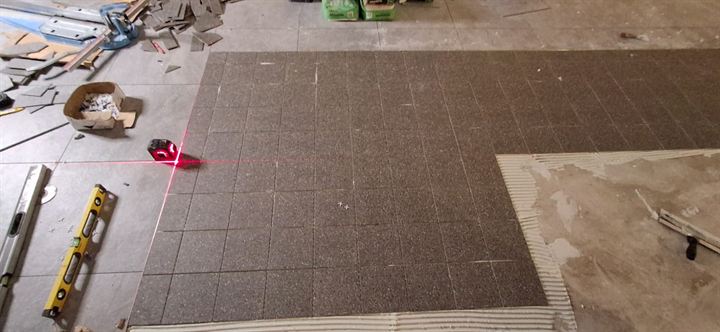
Before the first tile goes down, the job is set out on paper and on the floor. We find the centre lines, work out where the cuts will fall, and move the layout until they're balanced. The rules we tile by:
- No thin slivers at doorways or along the most visible wall. If a cut would come out as a sliver, we shift the layout until it doesn't.
- Grout lines that line up with the things you look at: the niche, the vanity, the window, the edge of the bath.
- Wall and floor joints that line up where the design calls for it.
- Any feature, border or pattern agreed with you before we start, not decided on the day.
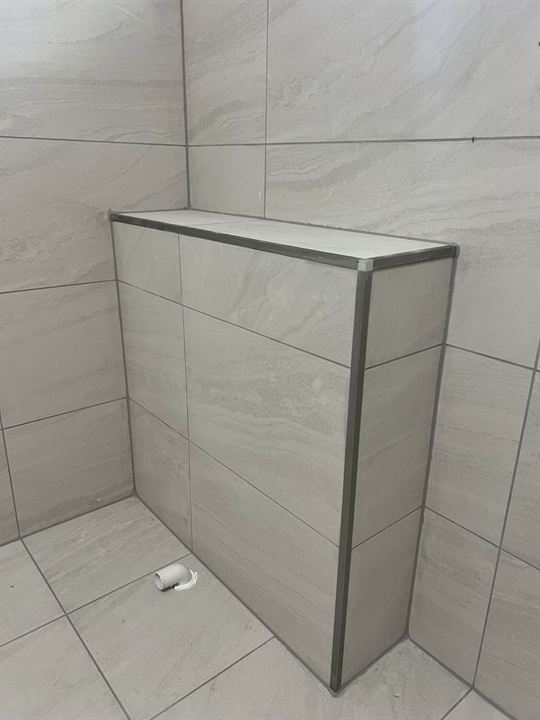
Mitre cuts and tile trims
Every external corner needs finishing, and there are two good ways to do it.
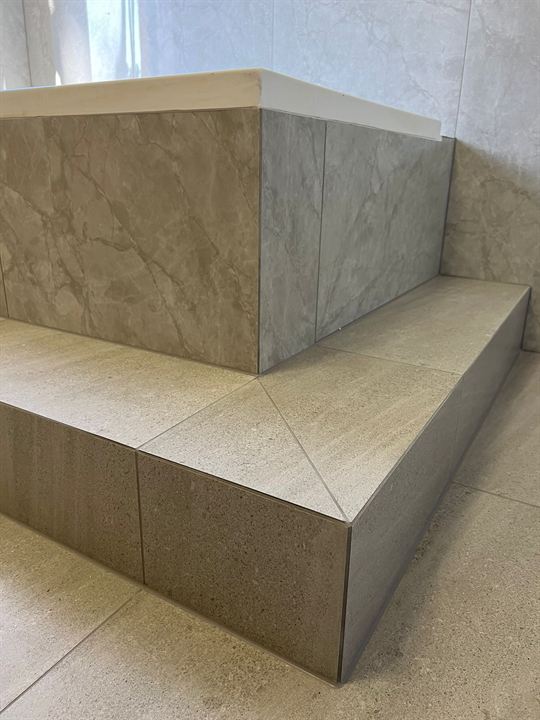
A mitre cut cuts both tiles at 45 degrees so they meet on the corner with no cut edge showing. It suits steps, bath hobs, niches and window reveals, and it takes time and a steady wet saw. We leave a tiny bevel on the point so the corner doesn't chip.
A tile trim is a metal or PVC profile set into the adhesive along the edge. Aluminium, brushed or polished stainless, or colour-matched finishes. Trims protect edges on high-traffic corners and on tiles whose body colour doesn't match the face, where a mitre would show a different colour.
Grout
Grout fills the joints between tiles. It isn't waterproof and isn't meant to be; that's the membrane's job. What grout has to do is stay put, keep its colour and clean easily.
- Cement-based grout for most homes. ARDEX FG 8 is flexible, suits joints from 1 to 8 mm, and has a mould inhibitor added.
- Epoxy grout where hygiene and stains matter: commercial kitchens, busy showers, pale grout on floors. ARDEX EG 15 is an easy-clean epoxy grout. It costs more and takes longer to lay, and it lasts.
- Joint width follows the tile. Rectified tiles, with machine-ground edges, can take a tight joint. Pressed tiles vary slightly in size and need a wider joint to keep the lines straight.
- Colour is chosen with you, against the actual tile, before the day.
Silicone and movement joints
Buildings move a little with heat, moisture and load. Where two surfaces meet, grout cracks because it can't flex. Those joints get a flexible sealant instead: internal corners, where the floor meets the wall, around the bath and shower base, and at perimeter and movement joints across big floors as AS 3958.1 requires.
Siliconing is the last thing we do, and it's the first thing people see. We use a sealant made for tiles, such as ARDEX SE, colour-matched to the grout, in straight, even lines, with the joint cleaned and dry first.
Pools
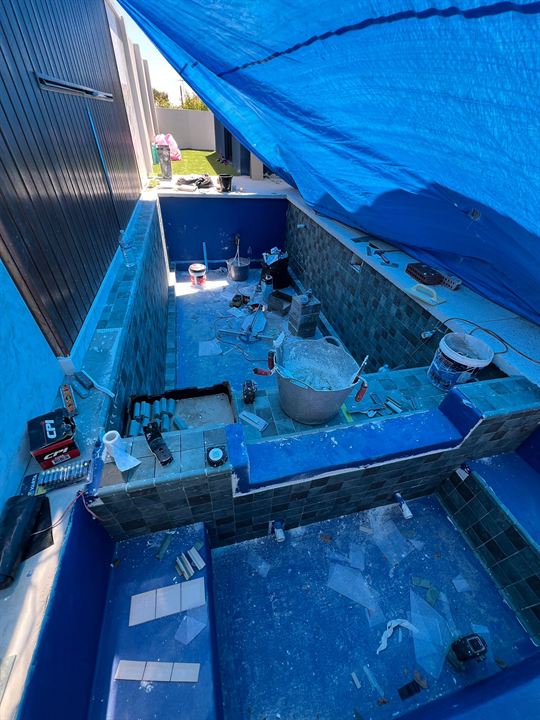
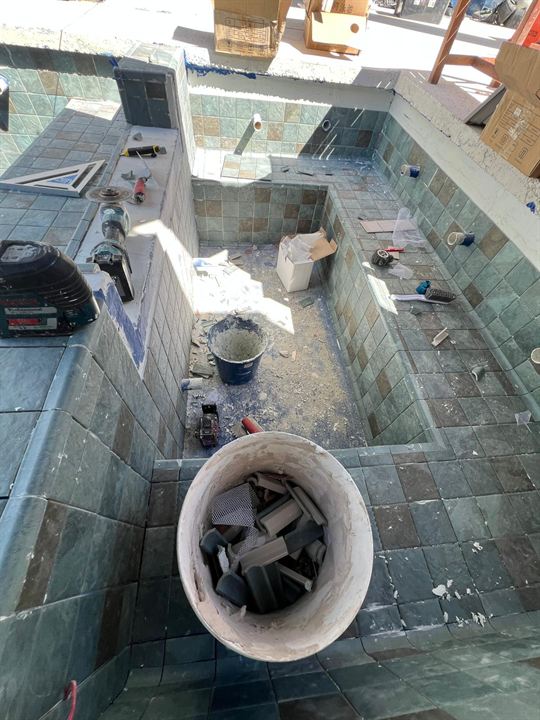
A pool is a wet area that never dries out, so everything under the tile has to be made for being underwater. The shell is prepped, then waterproofed with a pool waterproofing system such as ARDEX's. The walls, steps and benches are tiled and grouted in epoxy, which stands up to pool chemicals far better than cement grout. Mosaic and feature bands go in last. The pool isn't filled until everything has cured.
The products we use
These are the ones we reach for most. The exact product depends on the tile and the surface, and we'll tell you what's going into your job. We're not paid by ARDEX. We use it because it's consistent and backed by proper data sheets. Each name links to ARDEX Australia's own product page.
| Job | Product | What it does |
|---|---|---|
| Screed to falls | ARDEX A 38 | Rapid-set screed cement for falls and floors |
| Level a dry floor | ARDEX K 15 | Rapid-drying, self-levelling smoothing compound |
| Primer | ARDEX WPM 265 | Water-based primer before the membrane |
| Waterproofing | ARDEX WPM 002 | Two-part, fibre-reinforced undertile membrane |
| Waterproofing, faster | ARDEX WPM 155 Rapid Plus | Engineered undertile membrane, quicker to dry |
| Adhesive | ARDEX X 77 | Premium flexible wall and floor adhesive |
| Large and heavy tiles | ARDEX X 17 | Flexible, non-slump adhesive |
| Timber and fast jobs | ARDEX X 56 | Fast setting, highly flexible adhesive |
| Tricky surfaces | ARDEX Optima | Two-part adhesive, including over existing tiles |
| Grout | ARDEX FG 8 | Flexible coloured grout, 1 to 8 mm joints |
| Epoxy grout | ARDEX EG 15 | Easy-clean, high-performance epoxy grout |
| Movement joints | ARDEX SE | Flexible sealant for tile movement joints |
Tiling terms, explained
- Wet area
- A room where water is used: bathroom, shower, laundry, toilet. Covered by NCC Part 10.2 and AS 3740.
- Dry area
- Any tiled area that isn't a wet area, like living rooms, hallways and kitchen floors.
- Substrate
- Whatever the tiles are stuck to: concrete slab, screed, fibre-cement sheet, plasterboard or timber.
- Screed
- A sand-and-cement layer laid over the slab to level it or to create falls.
- Falls, screed to falls
- The slope of a floor towards the waste. In a shower, NCC 2022 requires between 1:80 and 1:50.
- Membrane
- The waterproof layer under the tiles. Usually a liquid applied in coats.
- Bond breaker
- A flexible strip or bead at a junction that lets the membrane stretch instead of tearing.
- Puddle flange
- A collar around a floor waste that joins the membrane to the drain.
- Waterstop
- An angle set at the shower edge or doorway to stop water running under the tiles into the next room.
- Back-buttering
- Spreading adhesive on the back of the tile as well as the floor, for full coverage under large tiles.
- Lippage
- One tile edge sitting higher than the one beside it.
- Rectified tile
- A tile with machine-ground edges, so every tile is the same size and joints can be tight.
- Mitre cut
- A 45-degree cut on two tiles so they meet on an external corner with no cut edge showing.
- Tile trim
- A metal or PVC edge profile that finishes and protects a tile edge or corner.
- Movement joint
- A joint filled with flexible sealant, not grout, so the tiles can move with the building.
- Epoxy grout
- A two-part grout that resists stains, chemicals and mould. Common in commercial kitchens.
Want it done this way?
Call or text us with a few photos and your suburb. We'll come and look for free, and you'll get an itemised quote that says what's going in.
Where the numbers come from:
- NCC 2022, Housing Provisions Part 10.2: Wet area waterproofing (falls, waterproof and water-resistant areas, step-downs)
- AS 3740-2021, Waterproofing of domestic wet areas
- AS 3958.1, Ceramic tiles: guide to the installation of ceramic tiles (adhesive coverage, movement joints)
- ARDEX Australia: tile and stone installation systems